
Why Does a High-Speed Bag Machine Lose Accuracy Long Before a Major Breakdown?
Most failures begin as small changes: fiber dust on a sensor, a loosening fastener, a dry guide, an uneven anvil, a contaminated electrical filter, or a belt that slowly loses tension. Production continues, but web tracking, bag length, weld strength, cutting position, vibration, and reject rate begin to drift. If maintenance waits for a stop, technicians must diagnose several interacting faults under delivery pressure. Calendar-only schedules also fail when one machine runs three shifts and another runs twice a week. A practical program combines shift checks with operating-hour tasks and condition limits. It records findings, parts, settings, and follow-up work. The Manufacturer’s manual remains the controlling source, while the plant uses runtime and evidence to refine intervals. A Supplier should provide a Customizable maintenance matrix for every OEM or ODM module in the delivered line.
A reliable maintenance plan combines every-shift cleaning and safety checks with weekly inspections, hour-meter service points, condition-based limits, controlled lubrication, calibration, and documented corrective work. Zhengxin aligns the schedule with each machine configuration, material, speed, environment, and duty cycle.
The following framework helps plant managers build a schedule that supports production instead of creating unnecessary shutdowns. It separates every-shift operator care, trained-maintenance tasks, operating-hour checkpoints, calibration, condition monitoring, and Manufacturer service, then connects every intervention to safe release, quality verification, spare consumption, and recipe control.
Create a Baseline from the Manual, Duty Cycle, and Environment
Collect the final manual, lubrication chart, electrical drawings, pneumatic diagram, parts list, software backup, FAT records, and commissioning measurements. Record hours per shift, shifts per day, starts, changeovers, material GSM, maximum speed, dust level, temperature, humidity, and compressed-air quality.
- Use the actual hour meter or PLC runtime, not estimates from the calendar.
- Shorten inspection intervals for abrasive dust, high humidity, unstable power, or continuous operation.
- Separate inspection, lubrication, calibration, and planned replacement tasks.
- Assign each task to an authorized operator, technician, electrician, or Manufacturer engineer.
- Keep safety functions outside unauthorized production-adjustment access.
The schedule below is a planning baseline, not a replacement for the Supplier manual. Approve model-specific intervals and lubricants before use. Record the clean-machine measurements at commissioning so future technicians can compare like-for-like conditions instead of relying on memory.
Complete Every-Shift Cleaning and Start-Up Checks
At the start of each shift, inspect guards, emergency stops, abnormal noise, loose items, air pressure, alarms, and the previous log. Before cleaning, stop and isolate energy according to the approved procedure. Remove loose fiber and dust using methods that do not drive contamination into bearings, cabinets, or ultrasonic equipment.
| Every-shift point | Acceptance direction | Escalation trigger |
|---|---|---|
| Photoelectric eye and web guide | Clean lens, stable signal, secure bracket | False trigger, low margin, damaged cable |
| Rollers and folding path | Clean surface, free rotation, no wrap | Marking, runout, unusual resistance |
| Ultrasonic station | Clean pattern, normal sound, stable weld | Overload, heat, skip weld, metal contact |
| Knife and punch area | Clean cut, secure guard, no debris | Burr, incomplete cut, vibration |
| Air and electrical status | Normal pressure, no leaks or active alarm | Pressure decay, odor, overheating, trip |
Do not lubricate a point merely because it looks dry. Wrong oil, excess grease, and lubricant on fabric-contact surfaces can create failures.
Use Weekly and 250-Hour Inspections to Catch Early Wear
Weekly work should include a deeper clean, leak check, fastener inspection, belt and chain observation, cable and hose inspection, filter review, and test of documented safety devices by authorized personnel. At approximately 250 operating hours, use the Manufacturer-approved checklist to inspect wear points more systematically.
- Check web-guide response, dancer movement, tension repeatability, and roller alignment.
- Inspect horn, anvil, embossing wheel, bearings, and mounting security.
- Review knife, punch, die, and cutting-board condition against quality samples.
- Inspect pneumatic leaks, cylinder cushioning, regulator bowls, and drain function.
- Clean cabinet filters without exposing energized components or defeating enclosure protection.
If the OEM manual specifies a different interval, it prevails. The purpose of an hour checkpoint is to make high-duty machines receive service sooner than low-duty machines.
Plan 1000-Hour and 2000-Hour Condition Reviews
Longer checkpoints should evaluate trends rather than automatically replace every component. At around 1000 hours, review drive belts, bearings, gearboxes, couplings, brake or tension assemblies, cooling paths, ultrasonic-stack condition, electrical terminals under an approved procedure, and sensor calibration. At approximately 2000 hours, add a broader geometry, performance, and safety review.
| Planning interval | Main purpose | Typical evidence |
|---|---|---|
| Every shift | Cleanliness and obvious abnormality | Checklist, alarms, sample bag |
| Weekly | Early looseness, leaks, and wear | Inspection log and photos |
| 250 hours | Focused mechanical and process review | Measurements and corrective work order |
| 1000 hours | Drive, ultrasonic, pneumatic, and electrical condition | Trend data and parts decision |
| 2000 hours | Integrated accuracy and safety review | Performance trial and updated baseline |
These are initial planning gates. Adjust them using findings, failure history, warranty terms, and written Manufacturer recommendations.
Maintain Calibration, Recipes, Backups, and Safety Functions
Mechanical care alone cannot preserve output. Verify bag-length measurement, encoder scaling, photoelectric tracking, web tension, temperature channels where installed, pressure gauges, counters, and alarm thresholds with suitable references. Protect PLC, HMI, drive, and safety settings through controlled access.
- Back up approved software and recipes before authorized changes.
- Record model, serial number, firmware, parameter version, and date.
- Test emergency stops, guard interlocks, restart prevention, and fault response using the approved procedure.
- Compare machine output with retained golden samples.
- Return temporary troubleshooting changes to the controlled baseline.
Maintenance on electrical equipment should follow applicable requirements and trained-person procedures, including the relevant principles of IEC 60204-1. Never bypass an interlock to reduce downtime. Store backups in two controlled locations and verify that the files can be opened before an emergency recovery is needed.
Trigger Condition-Based Work Before the Calendar Date
Use measurable triggers such as rising vibration, temperature, current, air leakage, ultrasonic overload frequency, web-correction activity, cut-position spread, weld-strength decline, and reject rate. A stable baseline makes a small change visible before failure.
| Trend | Possible direction | Maintenance response |
|---|---|---|
| Increasing weld variation | Tooling wear, alignment, material, thermal drift | Inspect station and compare approved fabric |
| More web-guide corrections | Roll quality, tension, roller contamination | Check incoming roll and web path |
| Longer pneumatic cycle | Leak, pressure drop, seal or valve wear | Measure dynamic pressure and isolate cause |
| Rising drive current | Mechanical drag, alignment, load change | Stop and inspect before overload |
Condition alarms should create a work order with evidence, not prompt an operator to widen limits without authorization. Review warning thresholds after sufficient stable data, and document who approved every revision.
Close Every Task with Records, Parts, and Verification
Record what was inspected, measured, cleaned, lubricated, adjusted, replaced, and tested. Include technician, runtime, material, recipe, part number, reason, before-and-after data, and next action. Link critical spare consumption to inventory reorder rules.
After maintenance, remove tools, restore guards, verify settings, complete a safe dry check, and run approved material. Measure bag dimensions, tracking, welds, cuts, counts, and alarms before releasing production. Record the first accepted sample and the responsible approver. This creates a defensible release record. Repeat failures should trigger root-cause review with the Supplier rather than another identical repair.
Send Zhengxin your machine model, serial number, duty cycle, material range, environment, and maintenance history. We can provide a Customizable OEM or ODM service matrix, critical inspection points, and original-part support for your production line.
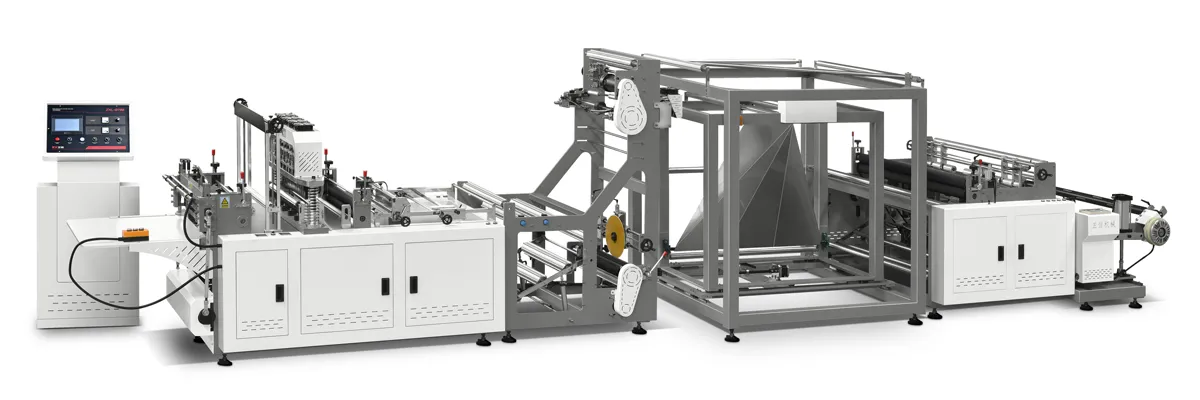
ZXL-A700背心袋无纺布制袋机.webp)
 አማርኛ
አማርኛ  English
  العربية
  Español
  Русский
  O‘zbekcha
  Қазақ тілі
  Português (AO90)
  Tiếng Việt
  (فارسی (افغانستان
  Kiswahili
  தமிழ்
தமிழ்  Bahasa Indonesia
  اردو
اردو  हिन्दी
  বাংলা
বাংলা