
Could a CE Sticker Still Leave Your Imported Machine Non-Compliant?
Yes. A logo on the nameplate does not prove that a non-woven bag making machine has a valid conformity assessment, risk assessment, electrical file, instructions, and signed declaration. EU importers must verify that machinery from outside the Union meets the applicable requirements before it is placed on the market. The timing is especially important: machinery placed on the EU market before 20 January 2027 follows the current Machinery Directive 2006/42/EC; the new Machinery Regulation (EU) 2023/1230 becomes mandatory from that date. A wrong model number, incomplete technical documentation, unsafe OEM change, or unsupported Declaration of Conformity can delay customs clearance and expose the importer to enforcement or retrofit costs. Compliance must therefore become a purchase specification and audit trail, not a document requested after final payment.
A qualified machinery Supplier must provide model-specific conformity evidence, a signed Declaration of Conformity, risk assessment, electrical and safety documentation, correct instructions, traceable nameplate data, and controlled test records. Zhengxin coordinates these items with the importer before FAT and shipment.
The checklist below helps importers and wholesalers separate a complete compliance package from a certificate-shaped sales document. It connects legal timing, machine identity, safety design, documentation, FAT evidence, and change control. It is practical procurement guidance, not a substitute for advice from the responsible EU authority or conformity specialist.
Confirm Which EU Machinery Rules Apply on the Placement Date
The European Commission states that machinery placed on the EU market before 20 January 2027 must comply with Directive 2006/42/EC. Regulation (EU) 2023/1230 applies on a mandatory basis from 20 January 2027. The relevant date is not simply the purchase-order date or factory completion date; the importer should document when the individual machine is first made available on the EU market.
| Market event | Primary machinery framework | Procurement action |
|---|---|---|
| Placed on EU market before 20 January 2027 | Machinery Directive 2006/42/EC | Verify Directive-based conformity package |
| Placed on EU market from 20 January 2027 | Machinery Regulation (EU) 2023/1230 | Verify Regulation-based obligations and declaration |
| Customized or substantially modified in the EU | Requires a separate legal assessment | Define who assumes Manufacturer responsibilities |
Other EU legislation may also apply to electrical, electromagnetic, radio, pressure, or environmental aspects. Build an applicability matrix for the exact configuration instead of copying the list from another machine.
Audit the Declaration, Nameplate, and Economic Operators
The Declaration must identify the Manufacturer, machine, model, and applicable legislation consistently. Compare it with the purchase order, serial number, nameplate, manual, drawings, and test reports. Confirm the signatory and the person authorized to compile or make technical documentation available as required by the applicable framework.
- Legal Manufacturer name and full address match across documents.
- Machine designation, model, serial number, and year are traceable.
- Applicable EU acts and standards are listed with correct references.
- The declaration is signed and dated by an authorized person.
- Сайт CE marking is visible, legible, and indelible.
- The EU importer’s identification obligations are addressed.
The European Commission notes that an importer must verify necessary documentation, including the declaration and technical documentation availability, and must be able to contact the Manufacturer. Private-label OEM or ODM sales can shift responsibilities, so agree the legal role before branding the machine.
Review the Risk Assessment and Safety Architecture
ISO 12100:2010 provides principles for machinery risk assessment and risk reduction. The assessment should cover the machine life cycle and actual hazards of a bag line: unwinding, nip and fold points, ultrasonic stations, hot surfaces where present, knives and punches, handle attachment, conveyors, electrical cabinets, pneumatic energy, cleaning, jam removal, setup, maintenance, and foreseeable misuse.
| Safety area | Reference direction | Evidence to request |
|---|---|---|
| Electrical equipment | IEC 60204-1 | Schematics, component list, tests, protective bonding |
| Safety-related controls | ISO 13849-1:2023 where applicable | Safety function specification and validation evidence |
| Emergency stop | ISO 13850:2015 | Location, function test, reset behavior |
| Mechanical hazards | ISO 12100 and applicable standards | Risk assessment, guards, interlocks, residual-risk warnings |
Listing a standard is not evidence by itself. The Supplier should show how each relevant risk is eliminated, guarded, controlled, warned about, and verified on the delivered configuration.
Demand a Model-Specific Technical Documentation Package
Agree the handover list in the contract. At minimum, the controlled package normally needs assembly and general arrangement drawings, electrical and pneumatic diagrams, bills of safety-related components, calculations or validation records where relevant, risk assessment, test reports, declarations, nameplate copy, installation conditions, and instructions.
- Freeze the approved configuration and option list.
- Assign document numbers, revisions, model, and serial-number applicability.
- Review safety circuits against the actual electrical cabinet.
- Confirm that instructions cover transport, installation, commissioning, operation, cleaning, maintenance, foreseeable faults, and disposal.
- Provide required language versions before the machine is placed on the target market.
A generic manual for a product family is not enough when the Customizable line has different guards, modules, voltage, control logic, or auxiliary equipment.
Put Compliance Tests into FAT and Close Every Non-Conformity
Use the Factory Acceptance Test to verify the physical machine against its file. Check protective bonding, emergency stops, guard interlocks, restart prevention, mode selection, fault alarms, isolation points, labels, rotation direction, pneumatic release, and safe access. Record results with instrument identification and acceptance limits.
- Witness each safety function rather than accepting a checkbox already completed.
- Match component models to schematics and the approved list.
- Photograph the final nameplate, warnings, guards, and serial number.
- Log every deviation in a non-conformity or punch list.
- Do not authorize shipment until critical findings are corrected and verified.
FAT does not replace conformity assessment, and a CE mark does not replace FAT. Together they connect the documentary claim to the delivered machine.
Control Changes After FAT, Installation, and Integration
A downstream printer, slitter, compressor, rewinder, or locally built conveyor can change the risk profile of the complete line. Define the boundaries, interfaces, emergency-stop behavior, guarding responsibilities, and declaration strategy before integration. Keep a change log for PLC software, safety parameters, electrical components, tooling, and mechanical modules.
If the importer markets the equipment under its own name or makes a substantial modification, it may assume Manufacturer obligations. Seek a qualified assessment before changing safety-related software or bypassing an interlock to increase speed. Site Acceptance Testing should confirm installation conditions, supply voltage, protective earth, access, lighting, air supply, training, and residual risks without silently altering the approved design.
Send Zhengxin your destination country, placement schedule, line configuration, voltage, language, and OEM or ODM requirements. We will align the compliance deliverables, FAT evidence, and final machine records with your purchase specification before shipment.
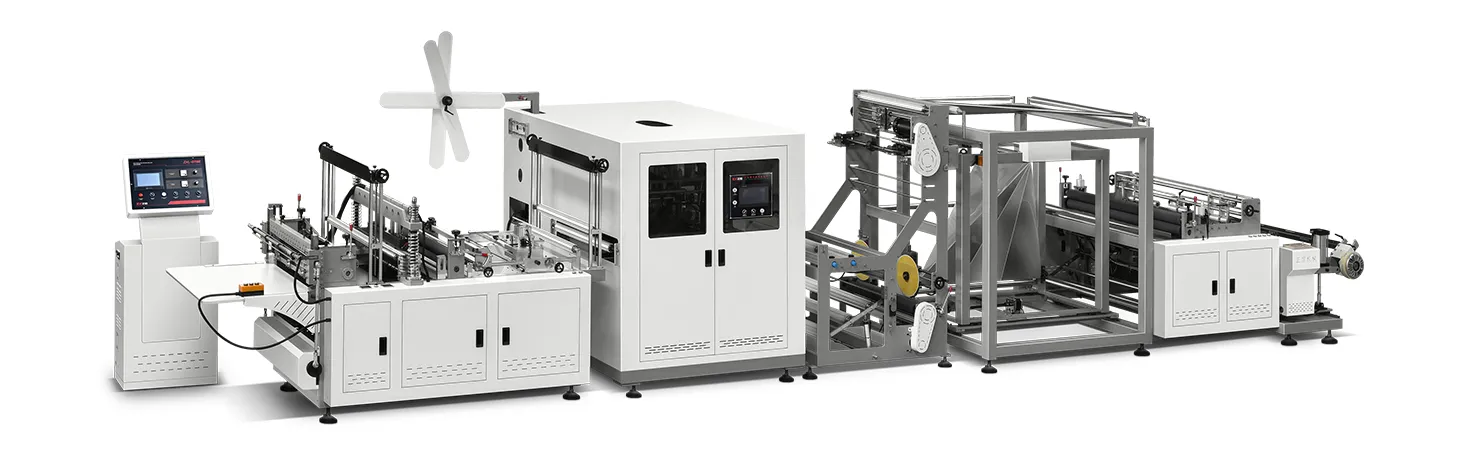
ZXL-A700背心袋无纺布制袋机.webp)
 Русский
  English
  العربية
  Español
  O‘zbekcha
  Қазақ тілі
  Português (AO90)
  Tiếng Việt
  (فارسی (افغانستان
  Kiswahili
  አማርኛ
አማርኛ  தமிழ்
தமிழ்  Bahasa Indonesia
  اردو
اردو  हिन्दी
  বাংলা
বাংলা