
Choose online handle attaching when stable, repeated handle-bag orders justify synchronized one-pass production. Choose an offline workflow when product mix, low batch size, special handle materials, manual quality work, or production balancing matters more than one-machine automation. The correct answer comes from good bags per shift, not the headline speed of either machine.
Online and Offline Describe the Material Flow, Not the Quality Level
In an online system, handle feeding, cutting, positioning, and attachment are integrated with bag forming. In an offline system, bag bodies and handles are produced or joined in separate steps. Either can make acceptable products when the process is designed and controlled correctly.
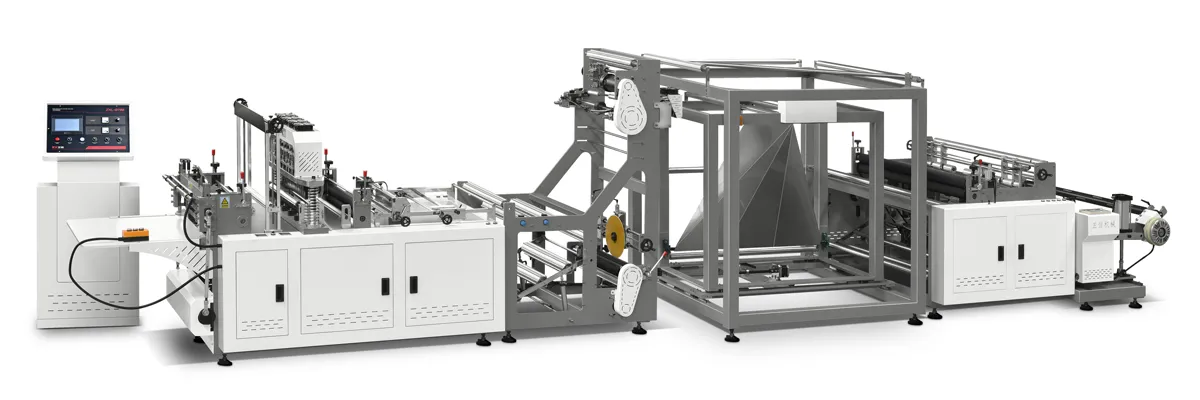
Zhengxin’s published ZXL-E700 configuration, for example, integrates online handle attaching with several bag-forming operations. That product page describes one model and its options. It should not be used as a universal performance promise for every size, fabric, handle, or artwork.
Compare the Two Workflows on the Same Commercial Basis
| Decision field | Online workflow | Offline workflow |
|---|---|---|
| Material flow | One linked route from roll to handled bag | Intermediate bags or handles move between stations |
| Work in process | Usually lower when the line is balanced | Can buffer one operation from another |
| Changeover | More stations may need coordinated setup | Individual stations can change independently |
| Labor | Less manual transfer, but skilled line setup remains | More handling, scheduling, and inspection work |
| Fault effect | One handle fault can stop the integrated line | Other stations may continue using buffers |
| Traceability | One production record can cover the full cycle | Intermediate lot identity must be preserved |
Do not compare an online peak rate with an offline average that includes breaks, or compare one operator with an unreported offline crew. Use the same bag, material, shift length, quality standard, and packing endpoint.
Calculate Good Output Through the Constraint
For an online line, the slowest required station sets the synchronized output. For an offline route, each station has its own rate, availability, yield, and staffing. The lowest effective capacity controls the final result unless inventory is deliberately built between operations.
Use this planning logic for each operation:
- Effective hourly output = demonstrated cycle rate × scheduled running fraction × first-pass yield
- Shift good output = effective hourly output × productive hours
- Labor content per 1,000 good bags = total direct labor minutes ÷ good output × 1,000
Use measured or Supplier-guaranteed inputs for the specified bag. Do not fill the worksheet with catalog maximums. A line that forms 100 bag bodies per minute but attaches 60 accepted handles per minute is a 60-bag process before other losses.
Let Product Mix Decide How Much Integration Helps
Map one month of real or forecast orders by bag style, size, handle type, fabric, print, batch quantity, and due date. Online integration is strongest when a large share of orders uses the same compatible process path. Offline capacity becomes useful when the factory must combine several bag-body machines with different handle options or make short campaigns.
| Order pattern | Likely direction | Question to test |
|---|---|---|
| High-volume repeated handled bag | Online may reduce transfer and WIP | Can the full line sustain accepted output? |
| Many short custom orders | Offline may isolate frequent handle changes | Which station carries most changeover loss? |
| Several bag-body lines, one handle family | Shared offline cell may pool demand | Will transport and queues erase the benefit? |
| Strict lot traceability | Either, with different controls | How are intermediate bags identified? |
| Limited floor space or labor | Requires layout and work-content study | What is the complete footprint and crew? |
Inspect the Hidden Work Around Each Machine
Online automation still needs roll loading, threading, tooling, recipe selection, first-piece approval, collection, packing, cleaning, and fault recovery. Offline production adds intermediate counting, containers, transport, queue control, reloading, and possible orientation work.
Draw a person-and-material flow for one order. Measure walking, waiting, lifting, searching, rework, and stack storage. If offline buffers are required, define minimum and maximum quantity. Too little buffer starves the handle station; too much hides defects and consumes space.
Compare Quality at the Handle, Not Only at Final Packing
Both routes should control handle material, loop length, placement, weld pattern, left-right symmetry, seam appearance, and the agreed strength test. Online detection may stop the complete line quickly. Offline inspection can isolate the attachment process but may discover a bag-body defect after additional work has been added.
- Identify the exact count point for produced and accepted bags.
- Record handle-material lot against bag-body lot.
- Separate attachment rejects from upstream bag defects.
- Keep rework rules and repeat welding limits explicit.
- Retain failure location, not only pass or fail.
Include Resilience, Maintenance, and Growth
An integrated line reduces handoffs but couples the stations. Ask what production can continue when the handle feeder, ultrasonic unit, sensor, or tooling is unavailable. An offline cell offers routing flexibility only if capacity, trained labor, floor space, and controlled inventory exist.
Compare critical spares, tool-change work, preventive maintenance, software backup, and support response for the complete route. Also model the next realistic product family. Buying flexibility for an undefined future can cost more than adding a documented module later.
Run a Matched Trial Before Choosing
Give each Manufacturer the same bag drawing, fabric, handle material, print condition, order mix, shift calendar, quality method, and labor boundary. Request a trial that records good output, scrap, changeover, stops, crew activity, and utility use for the named configuration.
Send Zhengxin this product-mix worksheet and your current process data. We can compare a standard, Customizable OEM, or ODM online configuration with a separate handle workflow and return stated assumptions, capacity constraints, and required tests.
ZXL-A700背心袋无纺布制袋机.webp)
 አማርኛ
አማርኛ  English
  العربية
  Español
  Русский
  O‘zbekcha
  Қазақ тілі
  Português (AO90)
  Tiếng Việt
  (فارسی (افغانستان
  Kiswahili
  தமிழ்
தமிழ்  Bahasa Indonesia
  اردو
اردو  हिन्दी
  বাংলা
বাংলা