
Choosing incompatible equipment can cause unstable production, excessive waste, poor bag quality, and delayed delivery. A properly configured production line prevents these costly problems.
A complete non woven bag production line generally includes a fabric slitting machine, flexographic printing machine, automatic bag making machine, ultrasonic welding system, air compressor, quality inspection tools, and packing equipment. The correct configuration depends on the required bag styles, printing colors, production capacity, raw materials, automation level, and available factory space.
Understanding each machine’s function helps manufacturers build a stable, efficient, scalable, and cost-effective non woven bag production line.
1. Non Woven Fabric Slitting Machine
A non woven fabric slitting machine prepares wide master rolls for printing and bag production. It cuts the original fabric roll into narrower rolls according to the required:
- ব্যাগের প্রস্থ
- Gusset size
- Handle dimensions
- Printing width
- Bag making machine specifications
Accurate slitting is essential because inconsistent roll widths can cause fabric deviation, uneven welding, incorrect bag dimensions, and unnecessary material waste.
A suitable slitting machine should provide:
- Stable tension control
- Accurate edge alignment
- Smooth rewinding
- Adjustable cutting widths
- Reliable speed control
Manufacturers producing several bag sizes should choose a machine with flexible width adjustment. Automatic tension control and edge-position correction can further improve feeding stability during continuous production.
2. Non Woven Printing Machine
A নন-ওভেন প্রিন্টিং মেশিন adds logos, product information, promotional graphics, and brand designs to the fabric before the bag-forming process.
Flexographic printing equipment is commonly used because it supports continuous roll-to-roll production and is suitable for high-volume orders.
The required printing machine should be selected according to:
- ছাপানোর রঙের সংখ্যা
- Printing width
- Graphic complexity
- Ink type
- Fabric thickness
- Required production speed
One-color and two-color machines are suitable for simple logos and text. Multicolor printing machines are more appropriate for detailed commercial designs and branded shopping bags.
Stable registration control is important for maintaining accurate image positioning. The drying system must also match the printing speed to prevent smudging, color transfer, and incomplete drying.
Manufacturers should confirm whether the equipment supports water-based inks and the intended non woven fabric specifications.
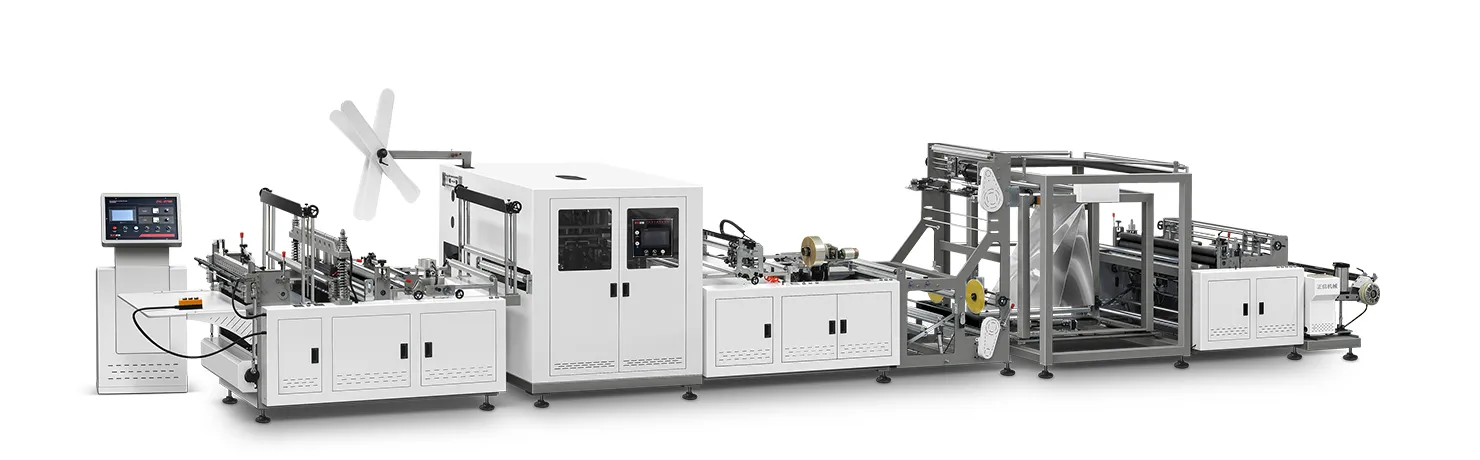
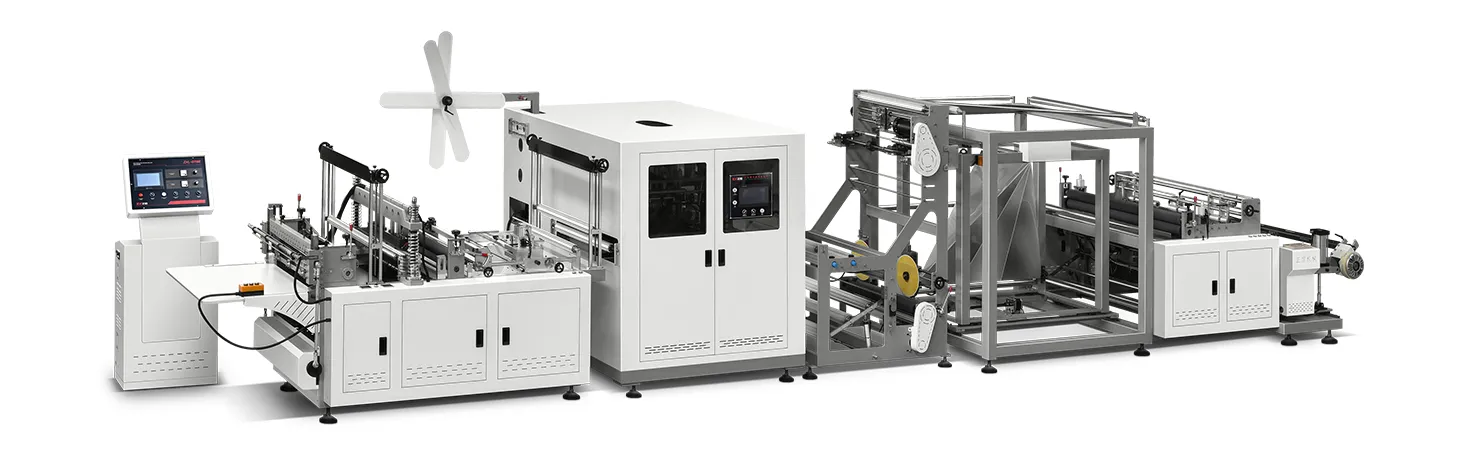
3. Automatic Non Woven Bag Making Machine
দ্য স্বয়ংক্রিয় নন-ওভেন ব্যাগ তৈরির মেশিন is the central unit of the production line. It converts printed or unprinted fabric rolls into finished bags through several automated processes:
- Material feeding
- Fabric folding
- অল্ট্রাসোনিক সিলিং
- Length measurement
- Bag cutting
- Handle punching or welding
- Finished-bag collection
Machine selection should be based on the required bag types. Common products include:
- নন-ওভেন শপিং ব্যাগ
- ফ্ল্যাট ব্যাগ
- টি-শার্ট ব্যাগ
- ভেস্ট ব্যাগ
- ডি-কাট ব্যাগ
- Loop-handle bags
- বক্স ব্যাগ
- Three-dimensional bags
Multifunctional machines can produce several bag styles by changing molds, attachments, or operating parameters.
Zhengxin develops non woven bag making equipment toward intelligent, automated, and precise production. Its three-dimensional bag making machines use touch-screen controls and can process non woven fabric, laminated fabric, PP material, transparent film, woven material, and composite fabric.
These machines can produce food bags, beverage bags, wine bags, clothing bags, gift bags, takeaway bags, insulation bags, and other commercial packaging products.
4. Ultrasonic Welding System
একটি ultrasonic welding system replaces traditional thread sewing or adhesive bonding in many non woven bag applications.
High-frequency vibration generates localized heat, allowing multiple fabric layers to bond quickly without additional glue.
Main advantages include:
- Clean and consistent sealing
- Fast welding speed
- Reduced consumable costs
- Improved bag appearance
- Lower labor requirements
- Stable production efficiency
Ultrasonic welding is commonly used for side sealing, bottom sealing, handle attachment, and reinforcement.
The ultrasonic power must match the fabric weight, number of layers, welding width, and machine speed. Insufficient power may create weak seams, while excessive energy may damage the fabric.
Reliable ultrasonic generators, durable welding horns, and stable pressure control are therefore essential for continuous production.
5. Handle Attachment Equipment
Some bag styles require separate handle attachment equipment.
Loop-handle bags, D-cut bags, and reinforced shopping bags may use:
- Automatic handle welding units
- Handle punching devices
- Reinforcement welding systems
- Separate handle forming machines
An integrated handle attachment system reduces manual labor and improves positioning accuracy. Separate handle machines may provide greater flexibility when producing customized bag styles or frequently changing handle specifications.
The equipment should be selected according to handle length, material width, welding strength, positioning tolerance, and required production output.
Manufacturers should also evaluate the time required for mold replacement when changing bag dimensions.
6. Air Compressor and Supporting Utilities
Pneumatic cylinders, punching devices, tension systems, and other machine components may require compressed air.
The selected industrial air compressor must provide sufficient pressure and airflow for all connected equipment.
The production area should also include:
- Stable electrical power
- Correct voltage and frequency
- Adequate ventilation
- Sufficient lighting
- Safe material-handling space
- Suitable machine maintenance access
Voltage stabilizers or transformers may be required when local electrical standards differ from the machine configuration.
Factories should also keep commonly used spare parts available, including ultrasonic components, cutting blades, heating elements, sensors, belts, switches, and electrical parts.
7. Quality Inspection Equipment
Quality inspection equipment helps maintain consistent bag dimensions, welding strength, printing quality, and overall appearance.
Useful inspection tools include:
- Measuring rulers
- Fabric thickness gauges
- Electronic scales
- Tensile testing devices
- Color inspection lights
- Seal-strength testing tools
Operators should regularly inspect:
- Bag length and width
- Gusset depth
- Handle position
- ওয়েল্ডিং শক্তি
- Printing registration
- Fabric condition
- Finished-bag appearance
Quality checks should be performed throughout production rather than only after an order is completed.
A documented inspection process reduces rejected products, customer complaints, material waste, and delivery risks.
8. Packing and Waste-Handling Equipment
Finished bags must be counted, stacked, bundled, packed, and prepared for storage or delivery.
Depending on the production volume, manufacturers may use:
- Manual packing tables
- Automatic counting devices
- Strapping machines
- Plastic sealing machines
- Carton-packing equipment
- Labeling systems
Waste-handling equipment is also important. Edge trim, defective bags, and fabric offcuts should be collected efficiently.
Some factories install compacting or recycling systems to reduce storage requirements, improve workshop cleanliness, and support material recovery.
How to Configure a Complete Production Line
The final equipment configuration should be determined by:
- Target bag styles
- Daily production capacity
- Printing requirements
- Fabric specifications
- Available labor
- Workshop size
- Investment budget
- Future expansion plans
A basic production line may include slitting, printing, bag making, compressed-air supply, inspection, and packing equipment.
A higher-output factory may also add automatic handle welding, multicolor printing, automatic material feeding, bag counting, waste collection, and centralized production monitoring.
Equipment compatibility is more important than selecting individual machines based only on price. Fabric width, printing width, feeding direction, production speed, electrical standards, and finished-bag specifications should be confirmed before installation.
A properly matched production line supports stable operation, consistent quality, controlled costs, flexible bag production, and future capacity expansion.
 বাংলা
বাংলা  English
  العربية
  Español
  Русский
  O‘zbekcha
  Қазақ тілі
  Português (AO90)
  Tiếng Việt
  (فارسی (افغانستان
  Kiswahili
  አማርኛ
አማርኛ  தமிழ்
தமிழ்  Bahasa Indonesia
  اردو
اردو  हिन्दी